Sections
How to watch anime with Japanese subtitles (and actually learn from it)
Short version: Japanese subtitles for anime are harder to find than they should be. Netflix has them for part of its catalogue, Crunchyroll almost never outside Japan, and the fan route (subtitle files plus a desktop player or extension) works but costs an evening of setup and only runs on a computer. If you want it to work on a phone in the next minute, use an app with a built-in catalogue and synced subtitles, such as Animei. Whatever you choose, the method is the same: watch with Japanese text, look up the words that repeat, and review them the next day.
Why Japanese subtitles, not English and not nothing
English subtitles feel like learning, but your eyes do the English reading and your ears tune the Japanese out. You finish the episode knowing the story and three words. Raw audio is the other extreme: for most learners below N3, spoken anime is too fast and too slurred to pick words out of, and an hour of not understanding anything is demotivating.
Japanese subtitles sit in the middle. The text slows the speech down to reading speed, shows you where one word ends and the next begins, and gives you something to look up. A word you have heard, read and looked up in the same second sticks far better than a flashcard. That is why every serious "learn Japanese with anime" method, from sentence mining to immersion, starts with Japanese text on screen.
The catch is that the subtitles need to be tappable. Reading a wall of kanji you cannot look up is just a harder version of raw audio. Each option below is really a question of how easy it makes the lookup.
Where Japanese subtitles exist in 2026
Netflix
Netflix is the one mainstream service that regularly carries a Japanese subtitle track for its anime, because it produces subtitles for the Japanese market. Open a title, pick 日本語 in the subtitle menu, and if it is there you are set. The share depends on your country and the licence of each show, so some titles will have it and others will not, and Netflix Originals are the safest bet. The lookup problem remains: on a TV or phone you can read the text but not tap it, and on desktop you need an extension (see below).
Crunchyroll
Crunchyroll's subtitle menu offers English and a list of other translation languages. A Japanese track for the Japanese audio is, as of this writing, almost never available outside Japan. Learners have been asking for it for years; the answer so far is no. If you watch on Crunchyroll, you will need to bring your own subtitle file and a player that can overlay it, which rules out the Crunchyroll app itself.
Subtitle files plus your own player
Fan archives such as kitsunekko collect Japanese .srt and .ass files for a large number of series, extracted from Japanese TV closed captions or typed up by volunteers. Load one into a desktop player next to your video and you have Japanese subtitles for anything you own. Two things go wrong in practice. Timing rarely matches, because different releases cut the opening and the recap differently, so you shift the subtitles by a few seconds and sometimes re-shift mid-episode. And a plain player gives you no dictionary, so you are back to pausing and typing words into Jisho.
Browser extensions on desktop
Language Reactor overlays dual subtitles and a popup dictionary on Netflix and YouTube. asbplayer does the same for any video in a browser tab, with your own subtitle files, and exports beautifully to Anki. Both are the right tools for a desktop learner with a Netflix subscription or a folder of videos. Both are Chrome extensions, which means neither runs on a phone or a tablet, and both assume you supply the subtitles or that Netflix has them.
Apps with a built-in catalogue
The last option skips the hunting. An app that already has the anime and the Japanese subtitles, synced to the video, with a dictionary built into the subtitle line, works the moment you open it, on whatever device you are holding. That is what Animei is: a catalogue of series with Japanese subtitles, tap-to-look-up words, and flashcards that keep the clip the word came from. The trade-off is that you are limited to its catalogue and its review system; it will not mine your Netflix account or export to Anki.
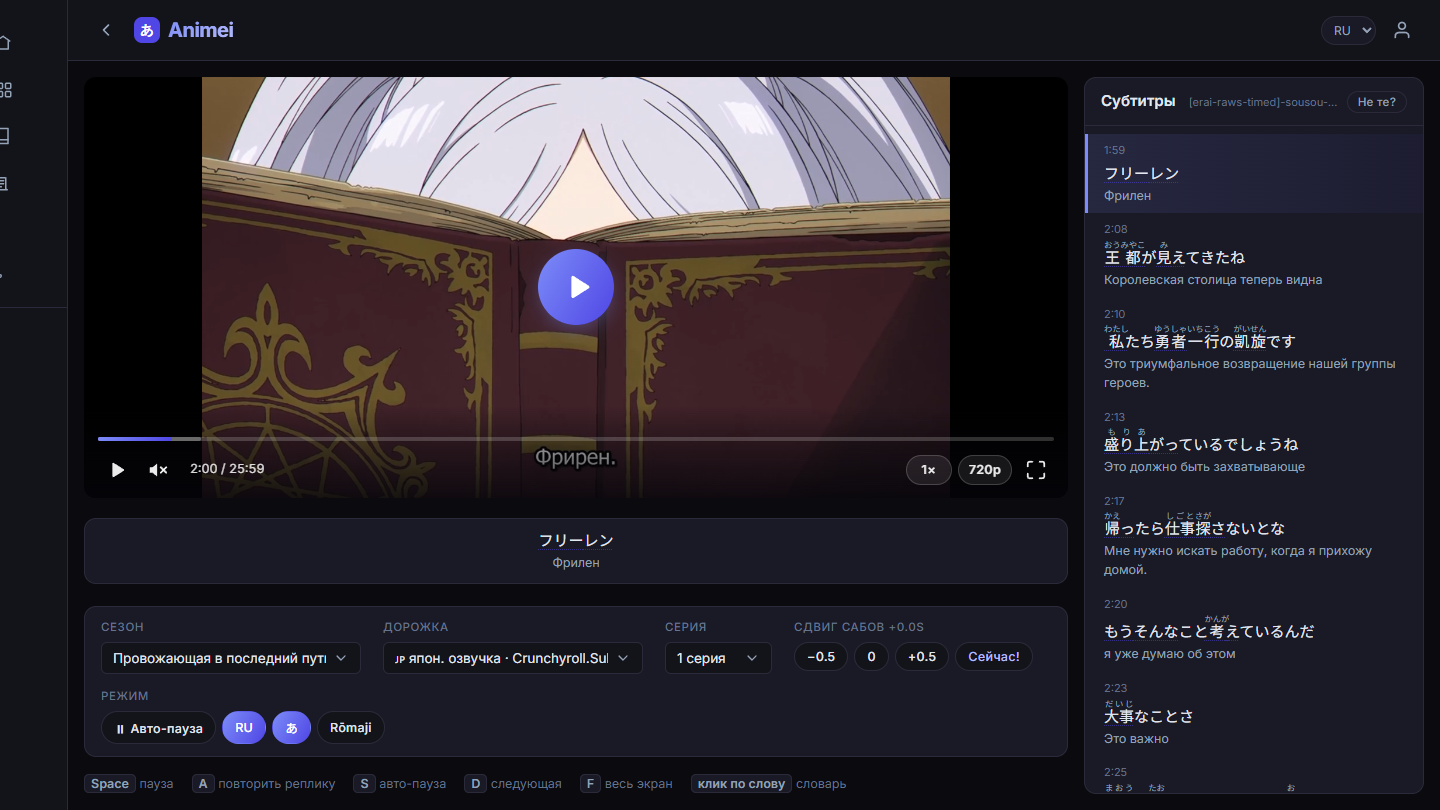
Which option is for you
| Netflix + extension | Subtitle files + asbplayer | Animei | |
|---|---|---|---|
| Where it runs | Desktop Chrome | Desktop Chrome | Any browser, phone or desktop |
| Japanese subtitles | If the title has a Japanese track in your region | You find and sync them | Included, synced |
| Setup | Install extension, 10 minutes | An evening: extension, dictionary, Anki, note types | None |
| Word lookup | Popup dictionary | Via Yomitan | Tap the word in the subtitle |
| Flashcards | Saved items, export | Anki cards with audio and screenshot | Built-in cards with the video clip |
| Catalogue | Your Netflix region | Anything you can play | Animei's catalogue |
| Cost | Netflix + optional Pro | Free | Free |
- You study at a desk and already use Anki: asbplayer with subtitle files. Nothing beats its cards.
- You have Netflix and watch on a laptop: Language Reactor, as long as your titles have a Japanese track.
- You watch on a phone, or you want to start tonight: Animei. Open the site, pick a series, press play.
- You are not sure which series to start with: our ranking of 42 series by how beginner-friendly their dialogue is, counted from the subtitles.
A routine that works
- Pick an easy show. Slice-of-life and school stories have far more everyday vocabulary than fantasy or military series. Erased, Horimiya and Violet Evergarden sit at the top of our ranking; Psycho-Pass and Soul Eater at the bottom.
- Watch a scene, not a word. Let a scene play with Japanese subtitles and aim to follow what is happening. Do not pause on every unknown word, or you will stop after ten minutes.
- Look up what repeats. A word you have seen three times in one episode is worth a tap. A word you will never see again is not. The first three episodes of most series reuse their core vocabulary heavily, which is exactly what makes them learnable.
- Save it with the line. A word with the sentence it came from, and ideally the clip, is a memory. A word on its own is a list entry.
- Review tomorrow, then next week. Spaced repetition is the part people skip, and it is the part that makes the vocabulary stay. Ten minutes a day is enough.
- Watch the number go up. Animei shows what share of an episode's words you already know. When a show you started at 40% reads at 70%, move up a tier.

FAQ
Does Crunchyroll have Japanese subtitles?
Outside Japan, almost never. The subtitle menu offers English and a set of translation languages, but a Japanese track for the Japanese audio is rarely there. Check the menu of the specific title in your region before counting on it.
Can I watch anime with Japanese subtitles on my phone?
Yes, but not with browser extensions, which only run in desktop Chrome. On a phone your options are Netflix titles with a Japanese track (no lookups), a player app with your own subtitle files, or a web app with a built-in catalogue such as Animei, which runs in the phone browser.
Is it better to watch with Japanese or English subtitles?
Japanese, with a way to look words up. English subtitles become English reading practice; no subtitles is too fast for most learners below N3. Japanese text connects the sounds you hear to words you can recognise and save.
Where can I download Japanese subtitle files?
Fan-maintained archives such as kitsunekko collect Japanese .srt and .ass files for many series. Expect timing to be off by a few seconds for your particular video, since different releases cut the opening differently.